
Categories
Buyers, Sellers, Walton CountyPublished February 25, 2026
Double Trouble in Social Circle? How Decertification and Mega-Projects Could Shake Up the Local Real Estate Market

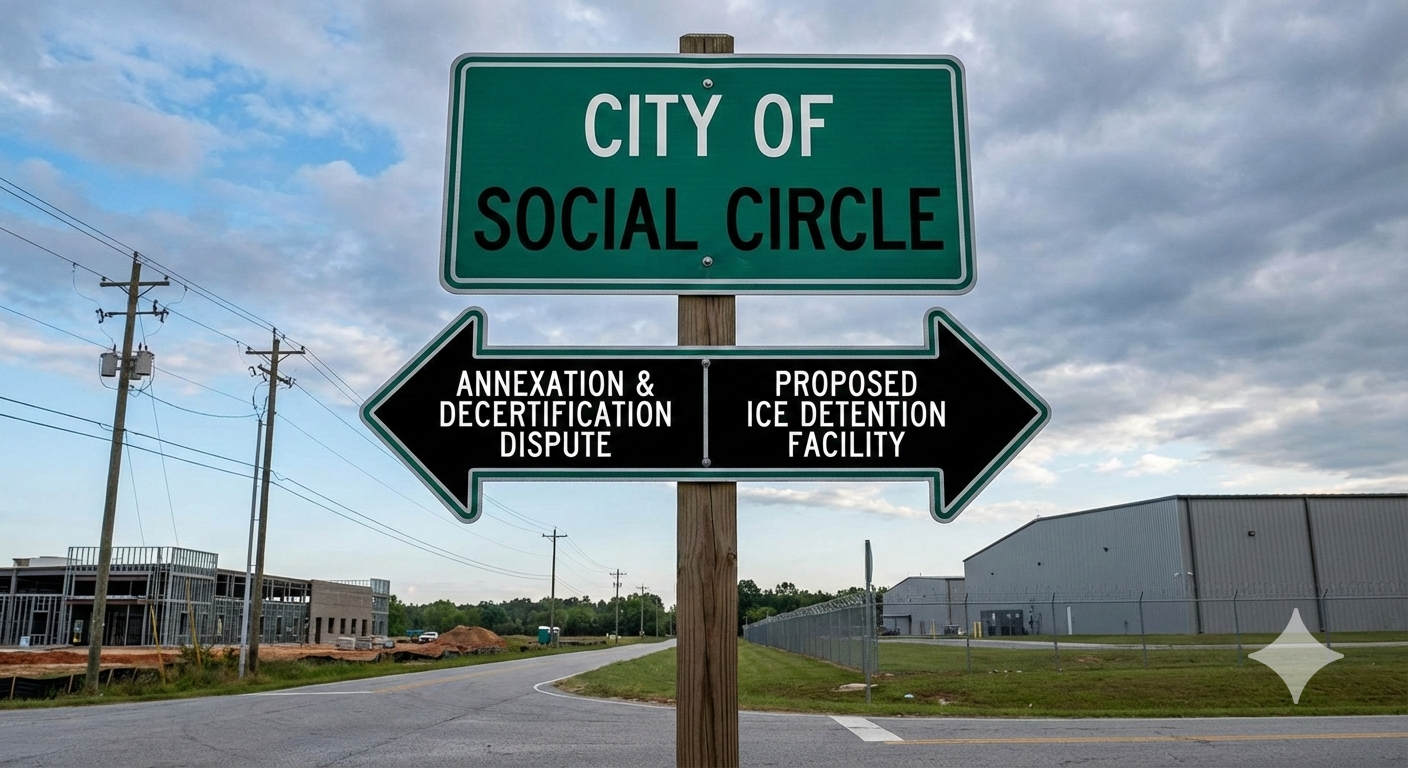
Social Circle, Georgia, a historically quiet city of about 5,000 residents straddling Walton and Newton counties, has suddenly found itself at the center of two massive, highly controversial development disputes. As of late February 2026, the city is staring down the barrel of losing its Qualified Local Government (QLG) status from the Georgia Department of Community Affairs (DCA).
Coupled with the looming threat of a massive federal detention center, the local real estate market is entering a period of intense uncertainty. For real estate investors, developers, and homeowners, these overlapping crises require a closer look.
Here is a breakdown of what is happening and how it could impact Social Circle's real estate landscape.
The Catalyst: Annexation, Arbitration, and Decertification
The immediate threat to Social Circle’s municipal standing stems from a 700-acre annexation of unincorporated land in Newton County (known as Stroud’s Creek). The city approved the annexation late last year to pave the way for a proposed data center.
However, Newton County objected and filed for arbitration. By moving forward with the annexation before the legal arbitration process concluded, Social Circle violated state statutes. As a result, the Georgia DCA issued a notice on February 17, 2026, threatening to strip the city of its QLG status.
What does losing QLG status mean? It cuts the city off from nearly 20 essential federal and state grant and loan programs, including:
• GEFA Loans: Funding for water and sewer infrastructure.
• CDBG Grants: Community Development Block Grants used for local improvements.
• OneGeorgia Authority Funds: Grants designed to spur economic development in rural areas.
The Real Estate Ripple Effects
If the DCA follows through with decertification, the effects on local real estate will be significant and multi-faceted.
1. A Freeze on New Residential Development
Real estate development relies heavily on municipal infrastructure. If Social Circle loses access to Georgia Environmental Finance Authority (GEFA) water and sewer loans, expanding utility lines to new subdivisions could grind to a halt. Without state-backed funding to upgrade capacity, builders will likely pause land acquisitions and new housing starts, creating a bottleneck in housing supply.
2. Potential Upward Pressure on Property Taxes
When cities lose access to state and federal grants for community projects, housing assistance, and historic preservation, the financial burden shifts. To maintain current community standards and complete ongoing municipal projects, the city council may be forced to look at raising local property taxes. For current homeowners and landlords, higher holding costs could eat into equity and rental yields.
3. Commercial and Industrial Uncertainty
The commercial real estate (CRE) sector thrives on predictability. The Stroud's Creek data center project is now mired in a jurisdictional tug-of-war. For industrial investors eyeing the I-20 corridor, Social Circle might temporarily look like a risky bet. If the city cannot guarantee zoning stability or infrastructure support, commercial developers may shift their focus to neighboring towns like Covington or Monroe.
The Elephant in the Room: The ICE Detention Facility
As if the decertification threat wasn't enough, Social Circle is simultaneously battling a separate, highly polarizing development. In late 2025, the U.S. Department of Homeland Security (DHS) purchased a 1.2-million-square-foot warehouse on East Hightower Trail for $128 million, intending to convert it into a massive ICE detention facility capable of holding up to 10,000 detainees.
While completely unrelated to the data center annexation, this facility compounds the real estate uncertainty:
• NIMBY Market Dynamics: Large detention facilities historically generate strong "Not In My Back Yard" pushback. Proximity to the facility could negatively impact residential property values and buyer demand in the immediate vicinity.
• Infrastructure Strain: Even though DHS claims the facility will use on-site utility systems, local officials—including Mayor David Keener—have voiced severe concerns about the strain on the city's broader resources, further underscoring the risk of the city losing its GEFA infrastructure funding.
The Bottom Line for Investors and Homeowners
Right now, the watchword for the Social Circle real estate market is caution.
• For Homeowners: There is no immediate need to panic-sell, but it is vital to monitor the city council’s response to the DCA. If the annexation dispute is resolved and QLG status is preserved, the worst of the infrastructure fears will be mitigated.
• For Investors and Developers: It is highly advisable to pause new land acquisitions in the contested Newton County borders until the annexation arbitration and DCA decertification threats are legally resolved. Furthermore, factor in the potential location of the ICE facility when evaluating future residential or commercial investments.
Social Circle is a beautiful, historic community experiencing severe growing pains. How city leadership navigates the next few weeks will dictate the trajectory of its real estate market for years to come.
Wondering How This Impacts Your Home’s Value?
The Social Circle market is shifting fast, and having hyper-local expertise is more important than ever. If you're curious about how these developments might be affecting your property's equity, let's talk.
👉 [Get Your Free, No-Obligation Home Valuation Today]

Chris Davis
| Chris Davis | Davis Team | Keller Williams Atlanta Partners
or another way