
Categories
Buyers, Loganville, Sellers, Walton CountyPublished January 9, 2026
The Real Story: Pros and Cons of Moving to Loganville, Georgia

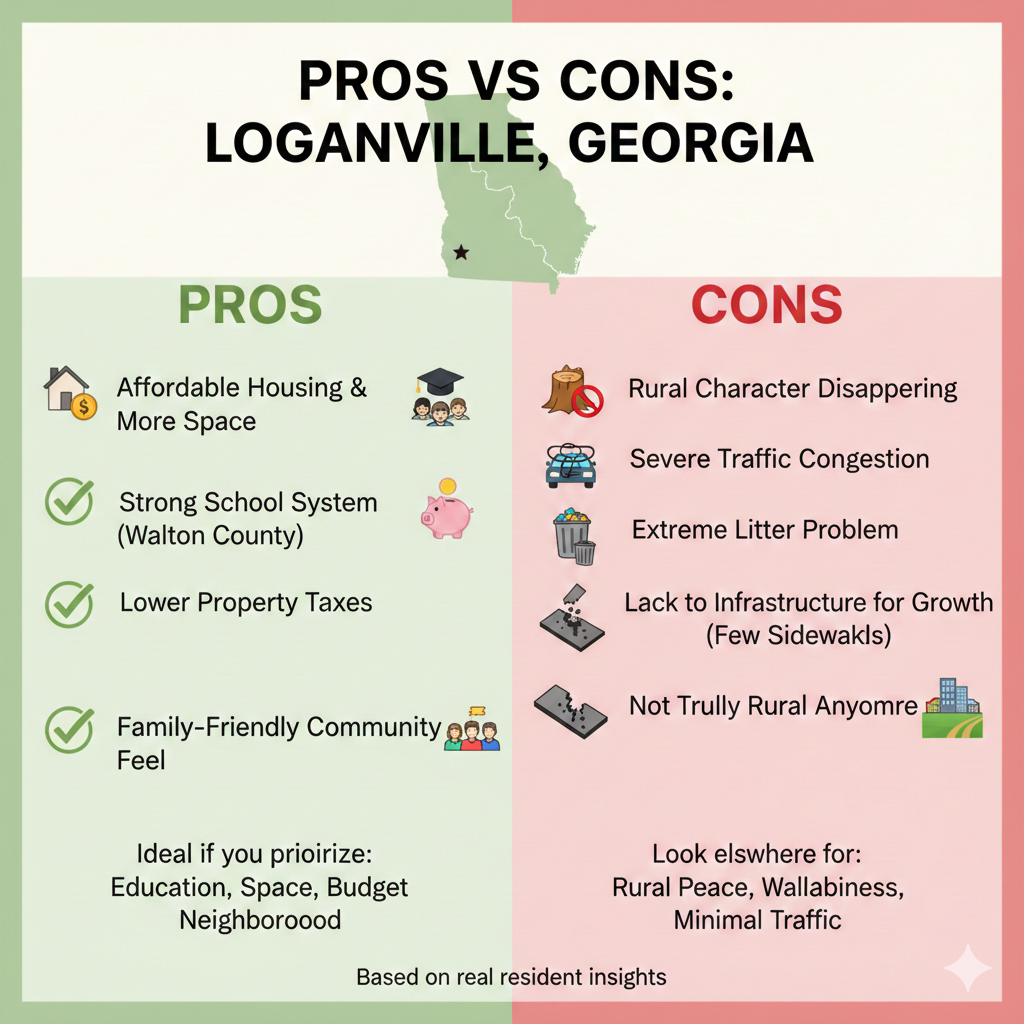
If you're considering a move to Loganville, Georgia, you're likely attracted by the promise of affordable housing, good schools, and a quieter lifestyle away from the hustle of Atlanta. But the reality is more nuanced than that. I've gathered insights from actual Loganville residents—some who've been there for decades, others who moved recently—to give you an honest look at what life is really like in this rapidly changing community.
"More house for the money" was the refrain I heard repeatedly from residents who moved within the last few years. If you're coming from areas like Lawrenceville, Snellville, or even Stone Mountain, your dollar stretches significantly further in Loganville.
One resident whose brother attended Loganville schools from elementary through high school confirmed that "the school system has always been great," a sentiment echoed by multiple families who specifically relocated for better educational opportunities.
One long-time resident put it bluntly: Loganville is now "Fulton and DeKalb combined," referring to Atlanta's most urbanized counties. The trees, wildlife habitat, and open spaces that once defined the area are being replaced by endless housing developments, condos, and townhouses.
If you're moving to Loganville expecting a rural haven, understand that you're arriving at the tail end of that era, not the beginning.
One resident noted it now takes over 15 minutes to drive 1.5 miles to Publix after 10 a.m.—a level of congestion that's shocking for what's supposed to be a quiet suburb.
This isn't just about aesthetics—it reflects a community struggling to maintain standards amid rapid expansion.
One resident who moved to escape crime in Stone Mountain lamented that growth has come "with no idea how to control the crime they introduced with all the rental properties."
Consider Loganville if you:
Current residents aren't warning you away from Loganville out of snobbery or gatekeeping. They're genuinely trying to manage expectations. If you move there hoping for the rural experience they once enjoyed, you'll likely feel the same disappointment they now express.
That said, if you understand what you're getting—a rapidly developing suburban area with good schools and relative affordability, but also traffic, growth pains, and infrastructure challenges—you can make an informed decision that fits your actual needs rather than an idealized vision of small-town life.
The Loganville of 2005, or even 2015, no longer exists. But the Loganville of today might still work for you—as long as you know what you're really getting into.
The Pros: Why People Move to Loganville
Affordable Housing and More Space
The most commonly cited reason for choosing Loganville is simple: you get more house for your money. Residents consistently mention finding larger homes with more property at prices that would be unthinkable closer to Atlanta. For families stretching their budgets, this value proposition remains one of Loganville's strongest selling points."More house for the money" was the refrain I heard repeatedly from residents who moved within the last few years. If you're coming from areas like Lawrenceville, Snellville, or even Stone Mountain, your dollar stretches significantly further in Loganville.
Strong School System
Parents consistently praise Walton County's school system as a major draw. The quality of education has remained a constant positive even among residents who are otherwise disappointed with recent changes. For families with school-age children, this factor alone makes Loganville worth considering.One resident whose brother attended Loganville schools from elementary through high school confirmed that "the school system has always been great," a sentiment echoed by multiple families who specifically relocated for better educational opportunities.
Lower Taxes
Coming from Gwinnett County? You'll appreciate the lower property taxes in Walton County. This financial benefit allows families to afford larger homes while keeping their overall housing costs manageable—a win-win for budget-conscious buyers.Family-Friendly Community Feel
Despite recent rapid growth, many residents still describe a sense of community in Loganville. It's the kind of place where neighbors know each other, where families can put down roots, and where there's still a small-town friendliness that's harder to find in larger suburbs.The Cons: The Uncomfortable Truth About Loganville Today
The Rural Character Is Disappearing Fast
Here's what current residents want you to know: the Loganville that attracted them is vanishing. Person after person described moving to Loganville for its rural feel, peace and quiet, and country atmosphere—only to watch it transform into "just another part of Atlanta."One long-time resident put it bluntly: Loganville is now "Fulton and DeKalb combined," referring to Atlanta's most urbanized counties. The trees, wildlife habitat, and open spaces that once defined the area are being replaced by endless housing developments, condos, and townhouses.
If you're moving to Loganville expecting a rural haven, understand that you're arriving at the tail end of that era, not the beginning.
Traffic Has Become a Serious Problem
The word "traffic" appeared in nearly every negative comment about Loganville. What was once a peaceful drive has become congested and frustrating. Residents describe awful traffic noise, difficulty getting to nearby stores, and dangerous road conditions.One resident noted it now takes over 15 minutes to drive 1.5 miles to Publix after 10 a.m.—a level of congestion that's shocking for what's supposed to be a quiet suburb.
The Litter Problem Is Real
Multiple residents mentioned an "extreme litter problem" that seems to have worsened with growth. Trash along roadsides, dirty tissues and masks in driveways, and poorly maintained commercial areas paint an unflattering picture. One resident even called out their local Aldi as "the nastiest" and "so littered, unkept."This isn't just about aesthetics—it reflects a community struggling to maintain standards amid rapid expansion.
Lack of Infrastructure for Growth
The explosive building hasn't been matched by infrastructure improvements. Residents complain about few sidewalks, making walking or jogging dangerous. The community feel is being lost as rental properties proliferate without adequate planning for the resulting density.One resident who moved to escape crime in Stone Mountain lamented that growth has come "with no idea how to control the crime they introduced with all the rental properties."
It's Not Really Rural Anymore
If you're looking for a true rural experience, multiple long-time residents suggest you'll need to look elsewhere—places like Hiawassee, Toccoa, Cleveland, or even South Georgia. Loganville has crossed the threshold from rural to suburban, and there's no turning back.So Should You Move to Loganville?
The answer depends on your priorities and timing in life.Consider Loganville if you:
- Have school-age children and prioritize education quality
- Need more space and can't afford it closer to Atlanta
- Work in the area or have a flexible commute
- Are looking for a neighborhood community rather than rural solitude
- Appreciate lower property taxes
- Want a truly rural lifestyle with minimal traffic
- Are seeking the peace and quiet of country living
- Can't tolerate rapidly increasing congestion
- Want a fully walkable community with good infrastructure
- Are bothered by visible litter and inconsistent area maintenance
Current residents aren't warning you away from Loganville out of snobbery or gatekeeping. They're genuinely trying to manage expectations. If you move there hoping for the rural experience they once enjoyed, you'll likely feel the same disappointment they now express.
That said, if you understand what you're getting—a rapidly developing suburban area with good schools and relative affordability, but also traffic, growth pains, and infrastructure challenges—you can make an informed decision that fits your actual needs rather than an idealized vision of small-town life.
The Loganville of 2005, or even 2015, no longer exists. But the Loganville of today might still work for you—as long as you know what you're really getting into.

Chris Davis
| Chris Davis | Davis Team | Keller Williams Atlanta Partners
or another way