
Categories
Buyers, Loganville, Sellers, Walton CountyPublished March 4, 2026
Tuck Road Multi-Family Rezoning: What It Means for Loganville

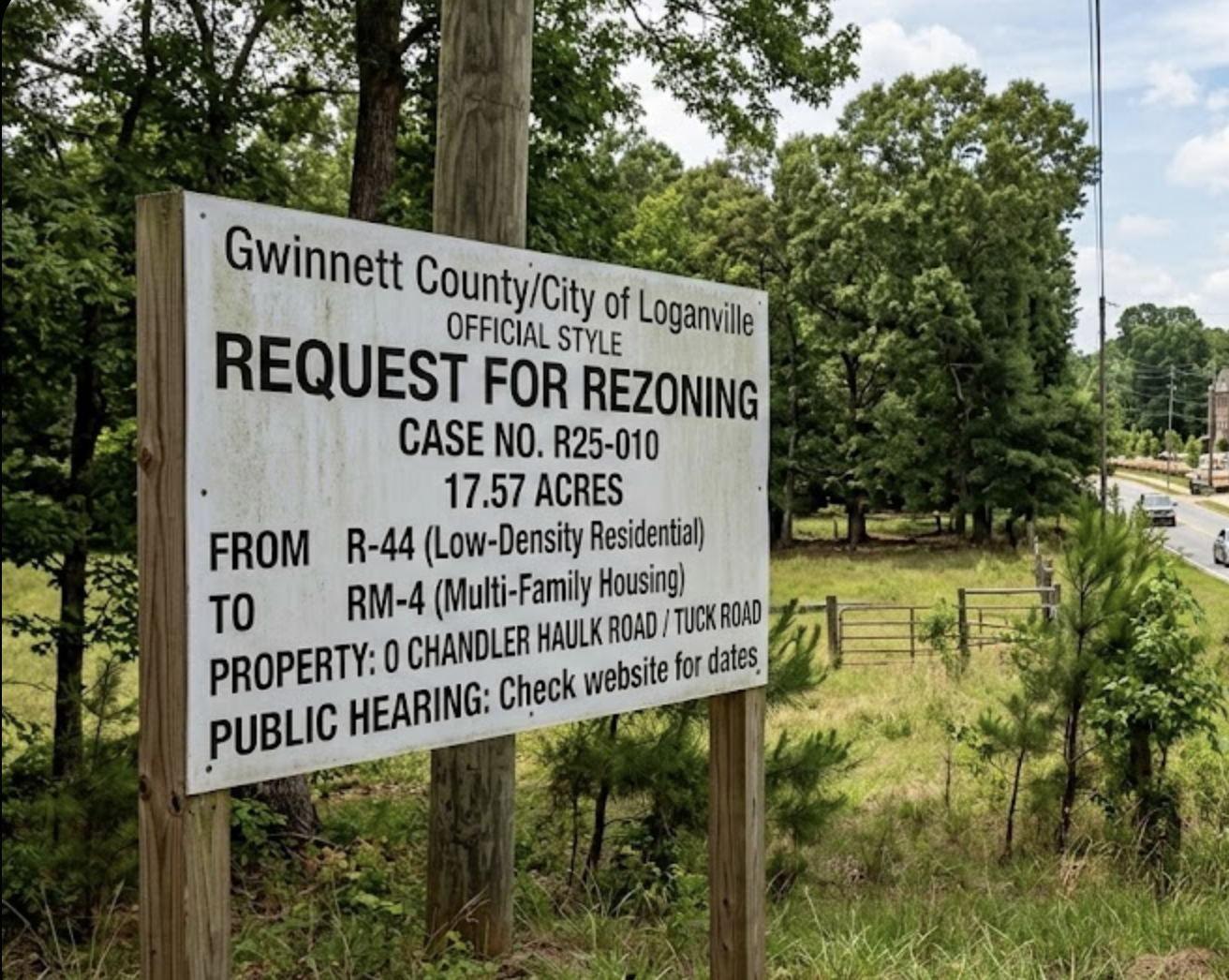
The Tuck Road Transformation: What the New Multi-Family Rezoning Means for Loganville
If you’ve driven down Tuck Road or Chandler Haulk Road lately, you’ve likely felt it: Loganville is changing. The quiet, rural stretches of Gwinnett and Walton Counties are meeting the "growth wave" head-on, and the latest development—Case #R25-010—is the perfect example of that shift.
The request involves roughly 17.57 acres (owned by Eddie H. Atha and Diane Atha Clay) transitioning from low-density residential (R-44) to multi-family housing (RM-4).
But what does that actually mean for your morning commute, your property value, and the "small-town" feel we all love? Let's break down why this specific rezoning is a game-changer for Loganville real estate.
1. The "Hidden" Catalyst: The Gwinnett–Loganville Sewer Agreement
You can’t talk about Loganville growth without talking about infrastructure. For years, density was capped by the lack of utility capacity.
However, the finalized Gwinnett–Loganville Intergovernmental Agreement (IGA) for water and sewer has officially removed the "stop sign." Now that the pipes are ready, the developers are too. When water and sewer capacity align, higher-density projects like townhomes and apartments become a mathematical certainty.
2. Why RM-4 Zoning? (The Housing Shortage Reality)
Let’s be real: finding an affordable starter home in Gwinnett or Walton County feels like winning the lottery right now. RM-4 zoning allows for roughly four units per acre, which typically translates to:
- Modern Townhomes
- Upscale Apartments
- Condominiums
From a market perspective, this is a supply-and-demand play. To keep Loganville accessible for first-time buyers, downsizers, and the local workforce, the city needs more than just sprawling estates. Without density, affordability simply doesn't exist.
3. Addressing the Elephant in the Room: Traffic and Schools
Every time a rezoning sign goes up, the same concerns come to the kitchen table. Residents are rightfully asking about:
- Traffic Congestion: Specifically the bottleneck potential at Tuck Road and Sharon Church Road.
- School Capacity: How will our local schools handle a sudden influx of students?
- Character: Can we grow without losing the "Loganville Identity"?
While the February 12, 2026, City Council meeting showed momentum for the project, "advancing" isn't the same as "finishing." Public input is still the most powerful tool residents have to ensure the city attaches the right conditions—like road improvements and green buffers—to the final approval.
At a Glance: The Tuck Road Rezoning
| Feature | Details |
| Case Number | #R25-010 |
| Location | 0 Chandler Haulk Road / Tuck Road |
| Acreage | 17.57 Acres |
| Current Zoning | R-44 (Low Density) |
| Requested Zoning | RM-4 (Multi-Family) |
| Status | Advanced at Feb 12, 2026 meeting |
Will This Hurt Your Property Value?
This is the #1 question I get. The honest answer? It’s all in the execution.
Historically, well-managed multi-family developments don't "tank" neighboring values. In fact, they often support them by:
- Attracting New Retail: Businesses follow rooftops. More residents mean better restaurants and shops nearby.
- Infrastructure Upgrades: Developers are often required to improve the very roads and utilities that neighbors use.
- Tax Base Expansion: More units mean more revenue for city services without a massive footprint.
The "villain" isn't the density itself—it's the site plan. The buffers and landscaping between the new units and existing homes will be the true factor in protecting your investment.
Final Take: Loganville at a Crossroads
Loganville isn’t a sleepy outpost anymore; it’s a vital hub in the path of Atlanta’s eastward expansion. We are currently balancing the demand for housing with the preservation of our community spirit.
The Tuck Road corridor is the new "front line" of this evolution. If you live in the area, stay engaged. This case sets the tone for what Loganville will look like in 2030 and beyond.
What do you think about the shift toward multi-family housing in Loganville? Leave a comment or reach out—I’d love to hear your perspective on how we should manage this growth.
Interested in how this affects your specific neighborhood? I can pull the latest property value trends for the Tuck Road area or set up an alert for the next City Council vote for you. Would you like me to generate a list of the specific zoning conditions being proposed for this site?

Chris Davis
| Chris Davis | Davis Team | Keller Williams Atlanta Partners
or another way